Three Ingredients. Here Is Why They Work Better Together Than Apart.
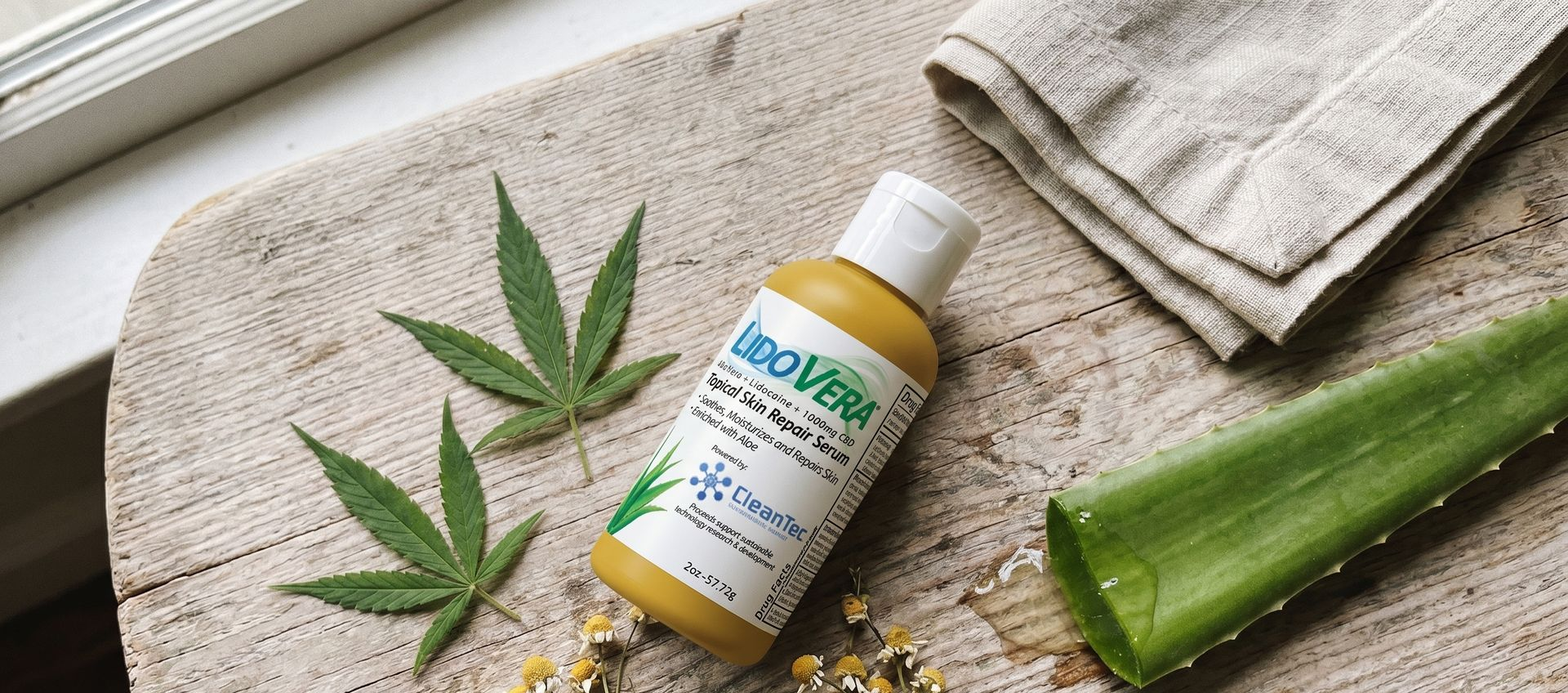
Quick Answer: LidoVera contains three active ingredients: aloe leaf gel, lidocaine, and a full spectrum hemp compound. Each one does a specific job that the others do not. The aloe delivers. The lidocaine handles the pain. The hemp compound supports the skin's own repair and inflammatory response. The combination covers more ground than any single ingredient alone - not because of marketing overlap but because the three biological mechanisms address different parts of the same problem simultaneously.
Key Takeaways
- Most topical products are built around one active ingredient and one primary use case. LidoVera's use case range - sunburn, bug bites, sore muscles, minor burns, eczema, psoriasis - is a direct result of three ingredients operating through three different biological mechanisms at the same time.
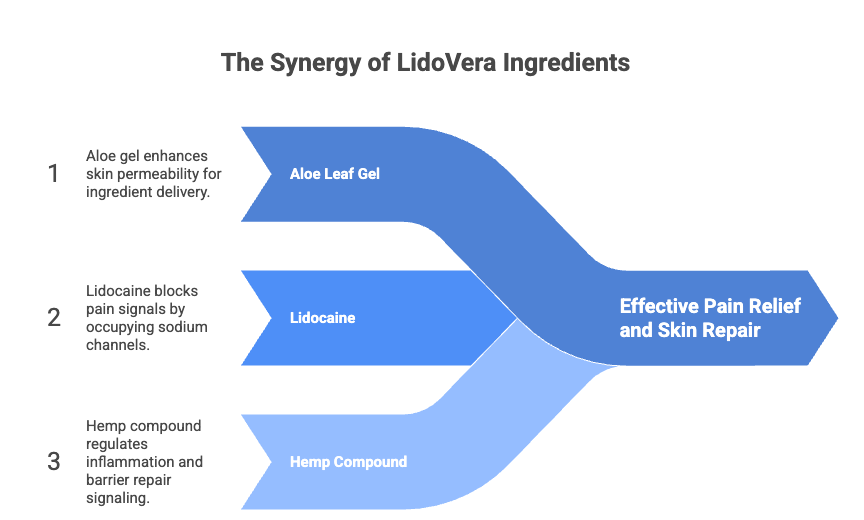
- Aloe leaf gel is the carrier. Without it, the lidocaine and hemp compound sit on top of the skin. With it, both compounds move through the outer epidermal layers to the tissue where they are needed.
- Lidocaine addresses the pain and surface sensitivity component through sodium channel blockade in the superficial nerve endings. It does not fix what is causing the pain - it interrupts the experience of it while the repair mechanisms work.
- The full spectrum hemp compound addresses the inflammatory and repair signaling component through CB2 and TRPV1 receptor activity in the skin's endocannabinoid system. It is doing something structurally different from what the lidocaine is doing.
- Cold amplifies all three mechanisms: it reduces baseline pain before the lidocaine starts working, slows the metabolic clearance of all active compounds at the application site, and extends the active life of the formula's ingredients.
- The formula's effectiveness across a wide range of conditions is not a coincidence of marketing. It is the predictable output of three mechanisms that collectively cover pain signaling, transdermal delivery, inflammatory regulation, and barrier repair.
- Understanding how the ingredients interact explains both the fridge recommendation and the Wednesday small-batch production model - both follow from ingredient behavior, not brand choices.
The four previous posts in this series covered each ingredient and its mechanism individually. This one covers what happens when all three are in the same bottle and applied to the same problem.
The short version: they are not redundant. Each ingredient is doing something the others are not. The interaction between them is what explains both the formula's range and the specific instructions that come with it.
The Problem With Single-Ingredient Topicals
Most topical products are designed around one primary mechanism. An after-sun lotion soothes. An antihistamine cream addresses histamine response. A lidocaine gel numbs. A CBD cream targets inflammatory receptors.
Each of these is a partial solution to what is usually a multi-component problem. A sunburn involves heat, pain, and skin damage simultaneously. A bug bite involves a foreign substance response, localized inflammation, and nerve irritation. Sore muscles involve lactic acid accumulation, microtrauma to fibers, and referred pain signals. Treating any of these conditions with one mechanism leaves the other components unaddressed.
LidoVera was not built by layering ingredients on top of each other to expand a marketing claim. It was built by asking what does this condition actually require and then selecting the compound that covers each requirement. The overlap between sunburn, bug bites, sore muscles, and inflammatory skin conditions is not accidental - all of them involve pain, inflammation, and a skin barrier that needs to repair itself. The formula addresses all three of those components because all three are present in all of those conditions.
The Delivery Mechanism: Aloe Leaf Gel as the Foundation
The aloe leaf gel in LidoVera is not a supporting ingredient. It is the mechanism that makes the formula work at all.
Skin's outermost layer - the stratum corneum - is a dense barrier whose job is to keep external substances out. Most topical compounds applied in water or petroleum-based carriers remain on this surface. They work from the outside in the most limited sense, affecting only the tissue they are physically touching.
Aloe leaf gel's polysaccharide structure, primarily acemannan, interacts with the lipid composition of the stratum corneum in a way that temporarily increases permeability at the application site. Active compounds carried in the aloe gel base move through the outer skin layers rather than sitting on top of them. The research on aloe's skin permeation enhancement function is documented - it has been studied specifically in the context of co-administered drug delivery.
For LidoVera this means that when the product is applied, the lidocaine and hemp compound are not staying on the skin surface. They are moving to the superficial nerve endings and skin receptors where they need to be to do their jobs. The aloe is not hydrating the skin as a side benefit while the other ingredients do the work. The aloe is the delivery infrastructure.
This is why the choice of aloe leaf gel over aloe extract or aloe water matters. Aloe water does not have the acemannan concentration needed to perform the permeation function. The delivery mechanism only works with the full gel form.
The Pain Response: Lidocaine's Specific Job
Once the aloe gel delivers the lidocaine to the superficial nerve endings in the epidermis and upper dermis, the sodium channel blockade begins.
Nerve cells transmit pain signals through rapid sodium ion movement across the cell membrane - sodium flows in, the electrical charge shifts, the signal propagates toward the brain. Lidocaine binds to the sodium channels and occupies them, preventing that ion movement. No depolarization occurs. The pain signal does not transmit.
This is a reversible process. The lidocaine does not damage the nerve or alter it permanently. It occupies the channel temporarily, is metabolized and cleared from the application site over time, and normal nerve function resumes. The duration of effect depends on concentration, how the product was applied, and individual physiology - but the mechanism is well established and the safety profile at OTC concentrations is decades-deep.
Lidocaine's role in the formula is specific: it handles the immediate pain experience while the repair process works. It does not reduce inflammation. It does not support barrier repair. It does not deliver the other compounds. It does exactly one thing - interrupts the pain signal - and it does that one thing reliably.
The secondary effect is also worth noting. Inflamed and damaged skin is in a heightened state of surface sensitivity that makes it less receptive to what is applied. Lidocaine's reduction of surface reactivity creates better conditions for the aloe and hemp compound to penetrate and act, rather than the skin responding defensively to the application.
The Repair Signaling: What the Hemp Compound Is Doing
While the lidocaine is handling the pain signal, the full spectrum hemp compound is addressing a completely different biological system.
The skin contains endocannabinoid receptors - CB2 and TRPV1 in particular - that are part of the system the body uses to regulate its own inflammatory response, barrier repair signaling, and pain modulation at the tissue level. These receptors are not the same as the sodium channels the lidocaine is occupying. They are a separate receptor system doing a different regulatory job.
Full spectrum hemp compound applied through the aloe delivery mechanism reaches these receptors and interacts with them. CB2 receptor activation is associated with modulation of the inflammatory response and acceleration of keratinocyte migration - the process by which skin cells cover and repair damaged tissue. TRPV1 receptor modulation contributes to pain reduction through a pathway that is distinct from lidocaine's mechanism, adding a second layer of pain coverage on top of the sodium channel blockade.
This is the reason the formula is effective on conditions with an inflammatory component beyond simple pain - eczema, psoriasis, bug stings, and the inflammation following a minor burn all involve the same CB2 and TRPV1 receptor activity that the hemp compound is targeting. The lidocaine alone would handle the pain. It would not address the inflammatory and repair signaling components. The hemp compound handles both of those.
Full spectrum is used rather than CBD isolate because the minor cannabinoids and terpenes in the full plant profile modulate and broaden the receptor activity in ways that isolated CBD does not replicate. For conditions involving multiple inflammatory pathways simultaneously - which is most of the conditions LidoVera is used for - broader receptor activity produces more consistent results.
Cold Temperature: The Fourth Variable
The instruction to refrigerate LidoVera is not a separate piece of brand identity layered on top of the formula. It is a direct consequence of how the three ingredients behave.
Cold and Lidocaine
Cold applied to inflamed tissue reduces the baseline firing rate of sensitized nerve endings before the lidocaine begins its sodium channel blockade. The physical cooling lowers the pain baseline, then the lidocaine works on top of that reduced baseline rather than starting from the full inflammatory state. Cold also causes vasoconstriction at the application site, slowing local circulation and reducing the rate at which the lidocaine is cleared. The lidocaine stays active at the site longer when the formula is applied cold.
Cold and the Hemp Compound
Cold slows the metabolic processes that degrade active compounds at the skin surface. The hemp compound's interaction with CB2 and TRPV1 receptors is extended when the formula is applied at refrigerator temperature rather than room temperature. The compound stays at the receptor site longer.
Cold and the Aloe Gel
Aloe leaf gel is biologically active. The same properties that make it effective as a delivery vehicle make it sensitive to heat over time. Refrigeration slows the degradation of acemannan and the other active compounds in the gel, extending the effective life of the formula. Room temperature storage does not ruin the product immediately, but refrigeration maintains the delivery function significantly longer.
Cold as a Mechanism, Not a Feature
The combination of physical cooling and the three active ingredients means that a cold application of LidoVera is producing five simultaneous effects: physical temperature reduction on the inflamed tissue, lidocaine sodium channel blockade, lidocaine effect extension through vasoconstriction, hemp compound receptor activation through the aloe delivery system, and hemp compound effect extension through slowed metabolic clearance.
The fridge recommendation is not a differentiator chosen for brand identity. It is the correct condition for the formula to perform at its best.
The Use Case Range Explained by the Mechanism
The conditions LidoVera works on are not a marketing expansion of the original sunburn use case. They follow directly from the biological mechanisms the three ingredients cover.
- Sunburn: heat and pain from UV-damaged surface tissue, inflammatory response in the epidermis. Lidocaine addresses the pain. Hemp compound addresses the inflammatory response and barrier repair signaling. Aloe delivers both and contributes its own anti-inflammatory enzyme activity. Cold amplifies all three.
- Bug bites and stings:
localized histamine and venom response, pain and itch from nerve irritation, surface inflammation. Lidocaine handles the nerve pain and itch signal. Hemp compound addresses the CB2 and TRPV1-mediated inflammatory response. Aloe delivers and adds barrier support.
- Minor burns: heat damage to surface tissue, pain from exposed nerve endings, subsequent inflammatory response. Same mechanism as sunburn with more acute pain component at the moment of application.
- Sore muscles and joints: referred pain signals from microtrauma and metabolic buildup beneath the skin surface, localized inflammation. Lidocaine penetrates through the aloe delivery system to reach the superficial nerve fibers carrying the pain signal. Hemp compound addresses the inflammatory component through the endocannabinoid system.
- Eczema and psoriasis flares: dysregulated inflammatory response at the skin surface, barrier dysfunction, discomfort from sensitized nerve endings. Hemp compound's CB2 modulation addresses the inflammatory dysregulation directly. Lidocaine addresses the discomfort. Aloe supports barrier repair.
The through-line across all of these is the same three components: pain at the nerve level, inflammation and repair signaling at the receptor level, and a delivery mechanism that gets both active compounds past the skin surface. LidoVera handles all three in every application because all three are present in every condition it is applied to.
The Production Model and Ingredient Integrity
The small-batch Wednesday shipping model is also explained by ingredient behavior rather than brand choice.
Aloe leaf gel degrades over time. The acemannan that makes it effective as a delivery vehicle breaks down more slowly in the cold and more quickly in heat. A production model that makes large batches and holds inventory in a warehouse means the product sitting at the back of the shelf has less active delivery function than the product made last week.
Wednesday dispatch from small-batch production means every order ships within the same week it was made. The formula reaching the customer is as close to the production state as the distribution model allows. Refrigeration handles the storage side. Small-batch production handles the freshness side.
Neither of these is a marketing choice. Both follow from understanding that ingredient integrity affects formula performance, and that the delivery mechanism - the aloe gel - is the most time-sensitive component in the bottle.
Frequently Asked Questions
Is LidoVera better than using each ingredient separately?
For the conditions it is designed for, yes - because the three mechanisms work together in ways that sequential or separate application would not replicate. The aloe delivery function works on whatever is in the formula at the time of application. Applying aloe first and then a lidocaine product on top of it does not produce the same transdermal delivery effect as having the lidocaine carried in the aloe gel base. The synergy is in the formulation, not just the combination of ingredients.
Can I use more than the recommended amount to get a stronger effect?
More product does not proportionally increase the effect. The delivery mechanism has a saturation point - more acemannan at the skin surface does not create proportionally more permeability. Apply a thin layer, allow 30 seconds for absorption, reapply as needed every few hours rather than applying a large amount at once.
Does the formula work differently on different conditions?
The mechanism is the same across all conditions - delivery, pain signal interruption, receptor-level inflammatory modulation. What varies is which component of the formula is doing the most work. On an acute sunburn the cold and lidocaine components are most immediately noticeable. On a sore muscle the hemp compound's deeper receptor activity may be more relevant. On an eczema flare the CB2 modulation and barrier repair support are likely the primary active mechanisms. The formula does not change - the balance of what the user notices changes based on what the condition requires most.
How long does it take to work?
Lidocaine's onset at the superficial nerve endings begins within 2 to 5 minutes of application when the aloe gel delivery system is working effectively. The hemp compound's receptor activity develops more gradually over the same timeframe. Cold application accelerates the initial pain reduction by lowering the baseline before the active compounds begin working. Most users notice meaningful relief within 5 to 10 minutes of application.
Is there anything in the formula that could interact with medications?
Topical lidocaine and topical hemp compounds at the concentrations in LidoVera have low systemic absorption on intact skin and are not associated with significant drug interactions in normal topical use. If you are taking antiarrhythmic medications, have a known lidocaine sensitivity, or are using prescription topicals on the same area, consult your doctor before use.
Does the order of the ingredients in the formula matter?
The ingredients are combined in the formulation process, not layered in sequence on the skin. The aloe gel base carries the lidocaine and hemp compound through the delivery mechanism as a single application. There is no user-side sequencing required - apply, let absorb, reapply as needed.
Sources
1. Hamman JH. Composition and applications of Aloe vera leaf gel. Molecules. 2008;13(8):1599-616. https://pubmed.ncbi.nlm.nih.gov/18794775/
2. Biro T, et al. The endocannabinoid system of the skin in health and disease. Trends Pharmacol Sci. 2009;30(8):411-20. https://pubmed.ncbi.nlm.nih.gov/19608284/
3. Topical Lidocaine for Chronic Pain Treatment. PMC. https://pmc.ncbi.nlm.nih.gov/articles/PMC8487862/
4. Baswan SM, et al. Therapeutic potential of cannabidiol for skin health. Clin Cosmet Investig Dermatol. 2020;13:927-942.
https://pubmed.ncbi.nlm.nih.gov/33335413/
Learn More About LidoVera