Aloe Vera Gel vs. Aloe Vera Extract: The Difference Actually Matters
Quick Answer: Aloe vera comes in three commercially available forms: aloe water, aloe extract, and aloe leaf gel. Most skincare products use the first two because they are cheaper and easier to stabilize. Aloe leaf gel is the only form that retains the full biological profile of the plant - the vitamins, amino acids, polysaccharides, and enzymes that make it useful for skin repair. It is also the only form that functions as a transdermal delivery vehicle, pulling active compounds through the outer skin layers rather than sitting on the surface. LidoVera uses aloe leaf gel for both of those reasons.
Key Takeaways
- Aloe vera exists in three commercial forms - water, extract, and leaf gel - and the form used in a product determines what it can actually do on skin.
- Aloe water and aloe extract are concentration-reduced forms that retain little of the plant's active compound profile. They are used primarily for cost and stability reasons.
- Aloe leaf gel contains the full range of bioactive compounds the plant produces: vitamins A, C, E, and B12, folic acid, a complete amino acid profile, polysaccharides, and enzymes including bradykinase.
- The polysaccharide structure of aloe leaf gel allows it to function as a transdermal delivery vehicle - it does not just sit on the surface of skin, it moves active compounds through the epidermal layers.
- Cold aloe leaf gel performs better on burned and inflamed tissue than room-temperature aloe. The physical cooling compounds with the biological activity of the gel.
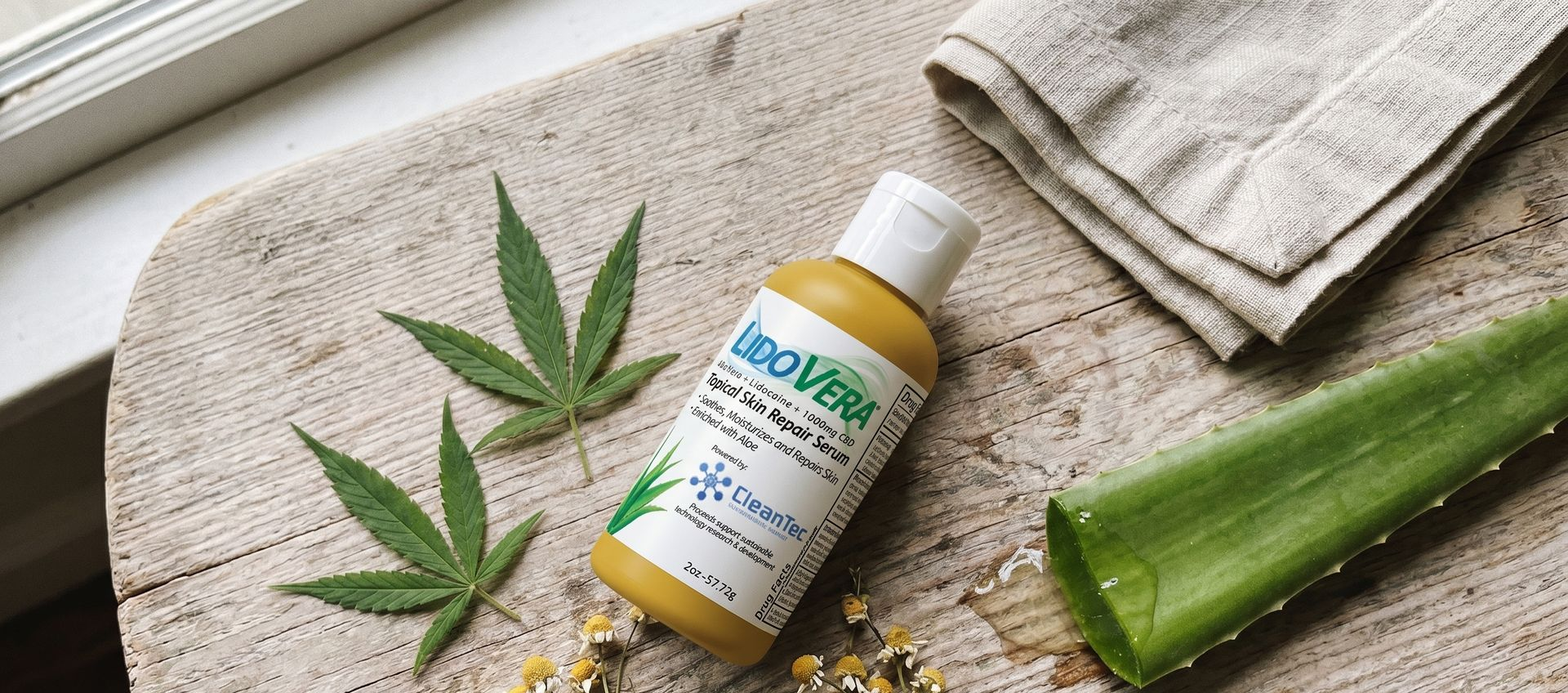
- LidoVera uses aloe leaf gel as the base because the lidocaine and hemp compound in the formula depend on it to penetrate the skin effectively. Without the gel carrier, both compounds remain on the surface.
- Reading an ingredient label as 'aloe vera' without knowing which form was used tells you almost nothing about what the product will do.
If you have ever used an aloe vera product that felt like it did very little, there is a good chance the issue was not aloe vera. It was which form of aloe vera was in the bottle.
This distinction is not widely discussed in skincare marketing because it does not serve the brands that use the cheaper forms. Understanding it changes how you read an ingredient label.
The Three Commercial Forms of Aloe Vera
Aloe vera as a plant produces a clear, viscous gel inside its leaves. That gel is biologically complex - it contains dozens of identified compounds across several categories. The challenge for product manufacturers is that this complexity makes it expensive to preserve and work with at scale.
The industry response has been to process aloe into more stable, more affordable forms. The result is three distinct products that all get labeled as 'aloe vera' on a consumer ingredient list.
Aloe Water
Aloe water is exactly what it sounds like - the liquid fraction of the aloe plant, mostly water with a small percentage of dissolved aloe compounds. It is the most heavily processed form and the least biologically active. It shows up in products primarily as a hydration claim and a cheaper alternative to distilled water as a base ingredient.
When a product lists 'aloe vera juice' or 'aloe barbadensis leaf juice' near the bottom of an ingredient list, you are almost certainly looking at aloe water. The concentration of active compounds is low enough that its functional contribution to the formula is minimal.
Aloe Extract
Aloe extract is a concentrated form produced by processing the plant material and extracting specific compound fractions. It contains more active compounds than aloe water but still represents a reduced and modified version of the plant's full profile. The extraction process selects for certain compounds and leaves others behind.
Extract is more potent than water and more shelf-stable than raw gel, which makes it common in mid-range skincare. It is a real ingredient doing a partial job.
Aloe Leaf Gel
Aloe leaf gel is the raw gel material from inside the aloe leaf, minimally processed to remove the outer rind and the latex layer beneath it, and stabilized for use in formulation. It retains the full compound profile of what the plant actually produces.
This is the form with the broadest biological activity and the most research behind its effects on skin. It is also the most expensive to source and the most technically demanding to work with. LidoVera uses aloe leaf gel because it is the only form that does the complete job the formula requires.
What Aloe Leaf Gel Actually Contains
The biological activity of aloe leaf gel comes from a specific set of compounds, each contributing something distinct to what the gel does when it contacts skin.
Vitamins
Aloe leaf gel contains vitamins A, C, and E - all antioxidants involved in skin repair and protection from oxidative stress. It also contains vitamin B12 and folic acid, both of which play roles in cellular function and tissue repair. Vitamin B12 in particular is rarely found in plant-derived topicals, which makes aloe gel an unusual source.
Amino Acids
Aloe leaf gel contains 20 of the 22 amino acids the human body uses, including 7 of the 8 essential amino acids. Amino acids are the building blocks of proteins, and at the skin level they contribute to collagen support, tissue repair, and barrier function. A complete amino acid profile in a topical ingredient is not common.
Polysaccharides
The polysaccharides in aloe leaf gel - primarily acemannan - are responsible for two things: the gel's hydration effect and its function as a transdermal delivery vehicle. Acemannan creates a film over the skin that reduces water loss, and its molecular structure allows it to interact with the skin's surface in a way that facilitates the movement of other compounds into the deeper epidermal layers.
This is the property that makes aloe leaf gel more than a moisturizer. It is a carrier. Other active ingredients formulated with it move deeper into the skin than they would in a different base.
Enzymes
Aloe leaf gel contains several enzymes, including bradykinase, which has been studied for its role in reducing inflammation when applied to the skin. Bradykinase breaks down bradykinin, a compound involved in the pain and inflammation response. This is part of the reason aloe gel has observable anti-inflammatory effects beyond simple cooling.
Minerals and Other Compounds
Calcium, magnesium, zinc, chromium, selenium, sodium, iron, potassium, copper, and manganese are all present in aloe leaf gel. Zinc in particular is associated with wound healing and barrier repair. These are not present in high concentrations but contribute to the overall biological activity of the gel.
The Transdermal Delivery Function and Its Implications
The most important property of aloe leaf gel for understanding LidoVera specifically is the transdermal delivery function.
Skin is designed to keep things out. The outermost layer - the stratum corneum - is a dense barrier of dead skin cells and lipids whose primary job is to block external compounds from penetrating. Most topical ingredients sit on top of this layer and work from the surface, which limits what they can do and how quickly they do it.
Aloe leaf gel's polysaccharide structure allows it to work with the skin's surface chemistry rather than against it. The acemannan in the gel interacts with the lipid layer in a way that temporarily increases permeability in the immediate application area, allowing compounds carried in the gel base to move through rather than sit on top.
For LidoVera this is not a secondary benefit. It is the mechanism that makes the formula work as designed.
Lidocaine needs to reach the nerve endings beneath the epidermis to produce its anesthetic effect. Applied in a water or petroleum base, topical lidocaine's penetration is limited. Applied in an aloe leaf gel base, the delivery mechanism is built into the carrier. The same logic applies to the full-spectrum hemp compound - its interaction with skin receptors happens below the surface, not on top of it.
The aloe leaf gel in LidoVera is not the base because aloe is a familiar skincare ingredient. It is the base because nothing else in the formula works correctly without it.
Cold Aloe and Its Effect on Inflamed Skin
Aloe leaf gel applied cold to sunburned or inflamed skin produces a noticeably different result than aloe applied at room temperature. This is not purely psychological.
The physical cooling effect reduces surface temperature and directly reduces the pain and heat sensation associated with a burn or inflammatory response. That cooling compounds with the bradykinase activity in the gel, which is working on the inflammatory pathway simultaneously.
Cold also affects the behavior of the other active ingredients in LidoVera. Lidocaine's anesthetic effect on inflamed nerve tissue is amplified by cold - the two mechanisms of pain reduction work together rather than independently. Cold additionally slows the metabolic processes that degrade active compounds, meaning the formula stays active longer at the application site when the skin is cold.
The instruction to keep LidoVera refrigerated is a direct result of understanding how these interactions work. A cold bottle on a sunburn is not a gimmick. It is the formula performing as designed.
Reading an Aloe Ingredient Label Correctly
Most consumer ingredient labels list aloe as one of the following:
- Aloe barbadensis leaf juice - aloe water, lowest active compound concentration
- Aloe barbadensis leaf extract - aloe extract, moderate concentration, modified profile
- Aloe barbadensis leaf gel - aloe leaf gel, full biological profile retained
- Aloe vera gel - same as above, less formal INCI nomenclature
Position on the ingredient list matters as well. Ingredients are listed in descending order of concentration. An aloe ingredient listed after fragrance or preservatives is present in a very small amount regardless of which form it is.
A product that lists 'aloe barbadensis leaf juice' as its fifth ingredient is using aloe water at a concentration high enough to do something. A product that lists the same ingredient near the bottom is using it as a label claim, not a functional component.
LidoVera lists aloe barbadensis leaf gel first. It is the base of the formula, present at the highest concentration of any ingredient in the bottle.
Frequently Asked Questions
Is aloe vera gel the same as the gel you squeeze out of a plant?
Essentially yes, with processing differences. Commercial aloe leaf gel is derived from the inner leaf of the aloe barbadensis plant, filtered to remove the outer rind and the latex layer, and stabilized for use in formulation. The compound profile is comparable to fresh leaf gel. The main difference is consistency and sterility rather than biological activity.
Does aloe vera gel expire?
Yes. Aloe leaf gel is biologically active, which means the compounds in it degrade over time, especially when exposed to heat and light. Refrigeration significantly slows this degradation. Products using aloe leaf gel as a primary ingredient benefit more from cold storage than products using aloe water or extract, because there is more active material to preserve.
Can aloe vera gel cause a skin reaction?
Aloe vera allergies exist but are uncommon. The more common source of irritation in aloe products is the latex layer of the aloe leaf - a yellow-brown resin called aloin that sits just beneath the outer rind. Properly processed aloe leaf gel removes this layer. If you have experienced irritation from an aloe product in the past, the likely cause was aloin contamination rather than a true aloe allergy.
Does the aloe in LidoVera function differently from aloe in a standard after-sun product?
Yes, for two reasons. First, LidoVera uses aloe leaf gel rather than aloe water or extract, so the full biological profile is present. Second, the aloe in LidoVera is functioning as a delivery system for lidocaine and a full-spectrum hemp compound, not just as a standalone soothing ingredient. The formula is built around what the aloe gel enables, not just what it does on its own.
Is aloe vera gel effective for conditions other than sunburn?
The research on aloe leaf gel covers a range of applications beyond sunburn, including minor wound healing, inflammatory skin conditions, and barrier repair. The anti-inflammatory activity of bradykinase and the transdermal delivery function are relevant to any condition involving skin inflammation or the need to deliver active compounds to sub-epidermal tissue. LidoVera's use case range - sunburn, bug bites, sore muscles, eczema, psoriasis - reflects the range of conditions where the underlying mechanism of the gel is relevant.
What is the difference between acemannan and other aloe polysaccharides?
Acemannan is the primary polysaccharide in aloe leaf gel and the compound most associated with its transdermal delivery and immune-modulating properties. It is a long-chain polysaccharide that has been studied for wound healing acceleration and anti-inflammatory activity. Other polysaccharides in aloe gel contribute to hydration and surface barrier effects. Acemannan is what distinguishes aloe leaf gel's delivery properties from simple moisturizing ingredients.
Shop LidoVera - $23 → cleantecsystems.com/BioBoost/LidoVera-Serum
Read also: What Do You Actually Need in a Topical Repair Serum? → /blog/what-do-you-need-in-a-topical-repair-serum
Sources
- Surjushe A, Vasani R, Saple D. Aloe vera: a short review. Indian Journal of Dermatology. 2008;53(4):163-166. PubMed. (https://pubmed.ncbi.nlm.nih.gov/19882025/)
- Hamman JH. Composition and applications of Aloe vera leaf gel. Molecules. 2008;13(8):1599-1616. PubMed. (insert URL)
- Vogler BK, Ernst E. Aloe vera: a systematic review of its clinical effectiveness. British Journal of General Practice. 1999. PubMed. (https://pubmed.ncbi.nlm.nih.gov/10885091/)
- Hęś M, et al. Aloe vera (L.) Webb.: Natural sources of antioxidants - a review. Plant Foods for Human Nutrition. 2019. PubMed. (https://pmc.ncbi.nlm.nih.gov/articles/PMC6684795/)
Learn More About LidoVera